



Engineering · Calculators
Thread engagement length calculator.
Preliminary engagement sizing from a simplified shear-area model and diameter rules of thumb. This is not a minimum safe engagement or a complete FED-STD-H28 analysis. Thread class, actual limit dimensions, shear strength, load sharing, temperature and joint loads require separate verification.
Failure-mode check
Bolt tension vs. thread strip capacity
At the recommended engagement the tapped threads carry more load than the bolt can — so the bolt yields/breaks before the threads strip, the desired ductile failure mode.
How to use this
Why engagement length is a strength problem, not a depth habit.
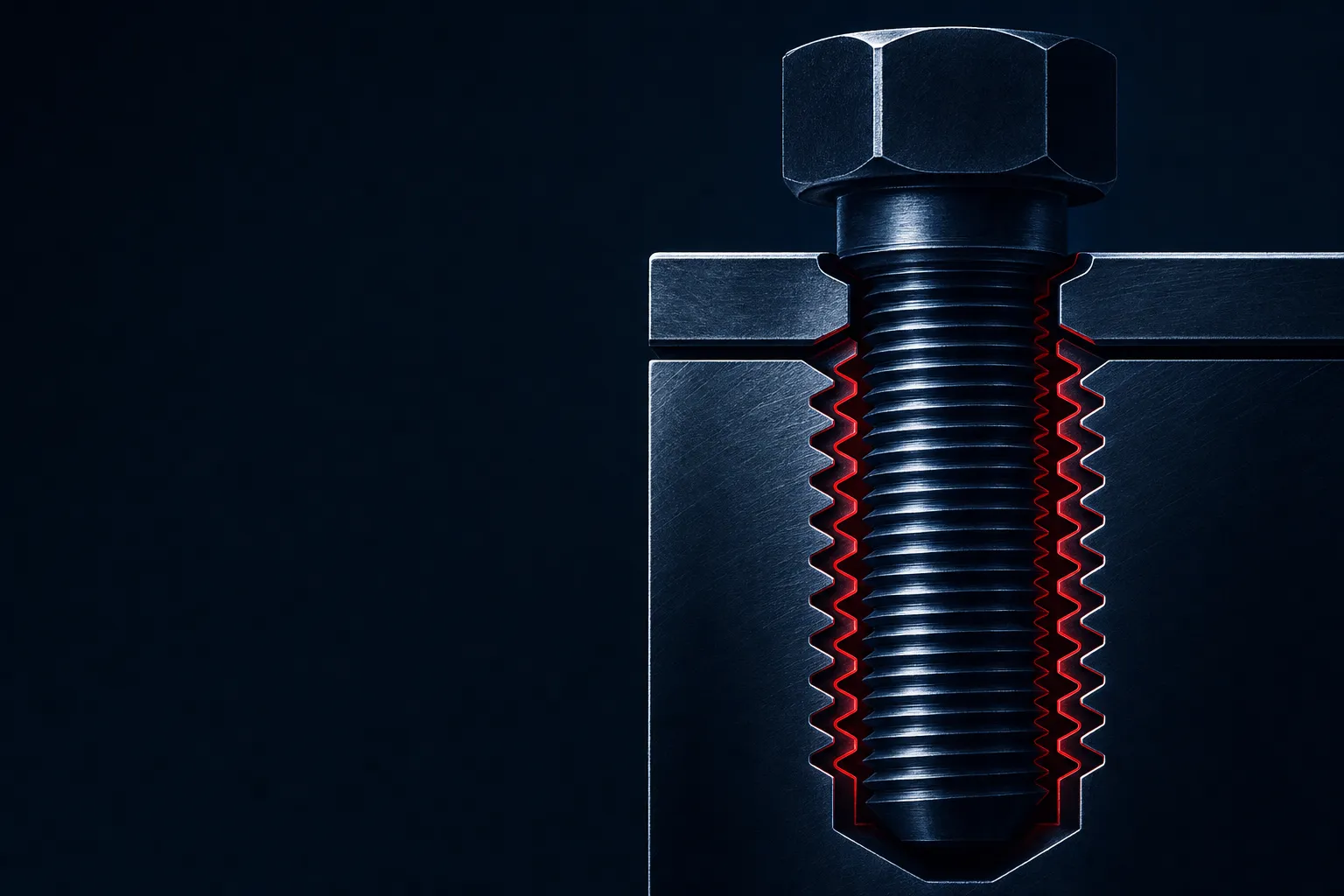
A threaded joint can fail two ways: the bolt snaps in tension, or the internal threads shear out of the tapped hole (stripping). Neither failure mode is acceptable in normal service. Engagement is one design variable; load distribution, thread tolerances, material condition, temperature and cyclic loading also matter.
Because thread shear area grows roughly linearly with engagement length, the fix for a weak tapped material is more engaged threads. A steel bolt threaded into steel needs only about 1× diameter; the same bolt into 6061-T6 aluminum needs roughly 2× diameter because aluminum's shear strength is far lower. Plastics and magnesium push past 2.5×D, and at that point a steel threaded insert is usually the better answer.
This tool computes both numbers: the textbook strength-based length (shear capacity ≥ bolt tensile capacity, scaled by the bolt-to-internal strength ratio) and the field rule-of-thumb multiplier. The larger value is only a screening scenario, even after the selected multiplier; it is not an approved minimum engagement. Pair it with the tap drill calculator to size the hole and the bolt torque calculator for a nominal torque scenario, not an assembly specification.
Related references: thread specifications, tap drill sizes, bolt torque, and drill size chart.
Values are engineering guidance for clean, well-formed threads in homogeneous material. Verify critical joints against FED-STD-H28, Machinery's Handbook, or your fastener supplier's data, and account for fatigue, temperature, and assembly tolerances. True Precision Machining is a CNC machining shop — we can machine and tap your part to spec; threaded-insert installation can be coordinated.
Keep exploring
Related tools & references
Tensile stress and shear areas this calc uses.
Size the drill for the tapped hole you're depth-checking.
Tightening torque for the joint once engagement is set.
Shear strength of the tapped material drives engagement length.
Need a part tapped to spec?
Send your drawing and we'll machine and tap your part to the engagement and class you need. Threaded-insert installation can be coordinated. Aerospace, medical, and defense work welcome.
Do not submit controlled technical data through public forms. Contact us first to arrange secure transfer of controlled drawings and requirements.
Quotes in 24 hours