

Engineering · Heat Treatment
Heat treatment reference.
What each process does, when to use it, and how the typical alloys we machine respond. The guide for designers who need to spec heat treatment thoughtfully.
Why heat-treat
Same alloy, different part.
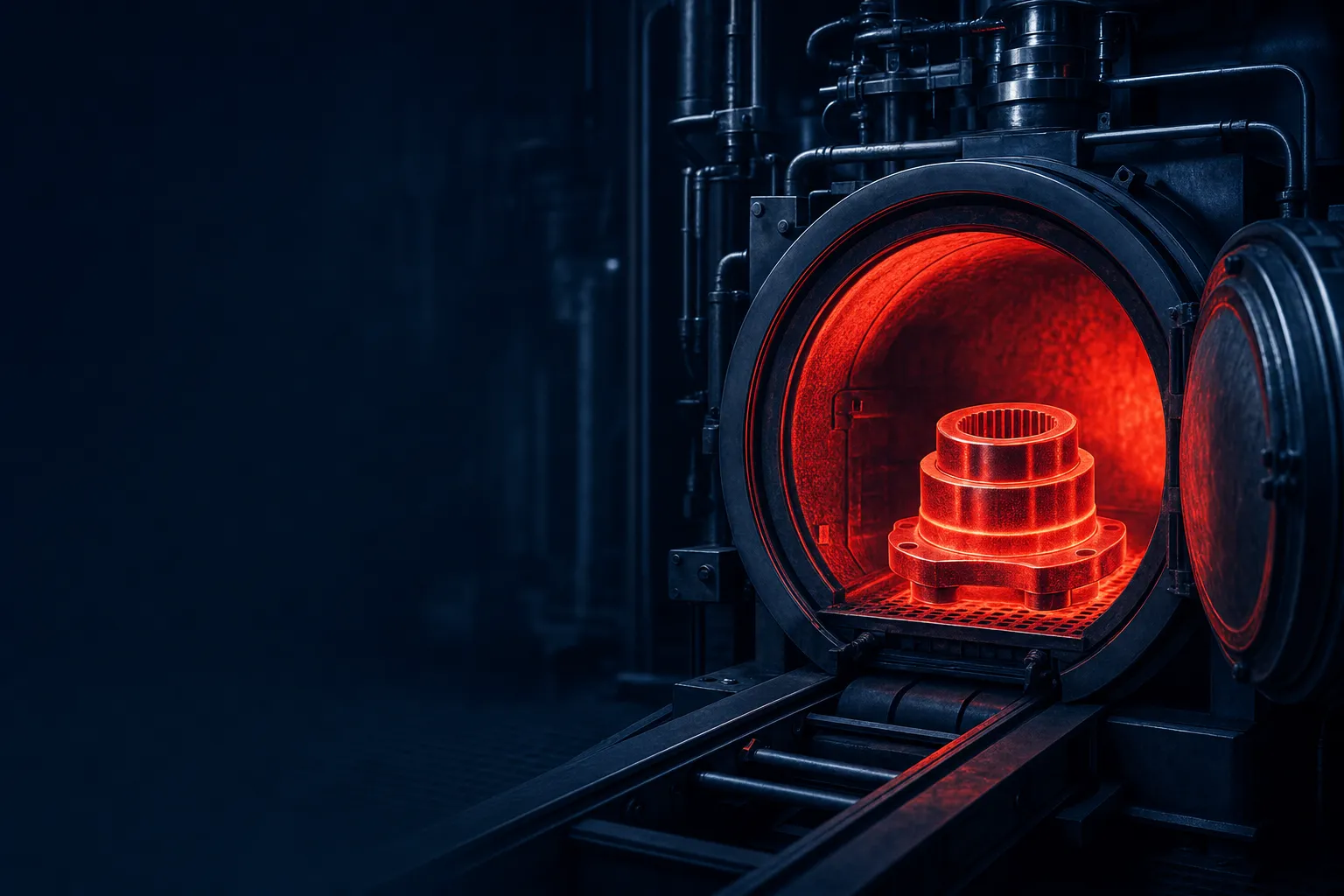
The same chemical composition can behave like soft butter or like a knife-edge — depending entirely on its thermal history. Heat treatment is how you tune properties to match the application: harder for wear, tougher for impact, more ductile for forming, more dimensionally stable for inspection.
The right heat treatment is usually decided early in the design phase — and called out explicitly on the drawing. Specifying "heat treat to 38–42 HRC" without naming the process leaves real ambiguity. Use the process names below.
The processes
Eight processes, distinct outcomes.
| Process | Goal | Typical temp | Cool from temp | Best for |
|---|---|---|---|---|
| Annealing | Soften, relieve all stress | 705 – 870 °C | Slow furnace cool | Ferrous alloys before machining |
| Normalizing | Refine grain, uniform structure | 815 – 925 °C | Air cool | Castings, forgings, weldments |
| Stress relief | Remove residual stress only | 550 – 675 °C | Slow | Post-machining, post-welding |
| Hardening (quench) | Form martensite, max hardness | 815 – 870 °C | Oil/water/polymer quench | 4140, 4340, low-alloy steels |
| Tempering | Trade hardness for toughness | 150 – 650 °C | Air cool | Always after hardening |
| Solution treatment | Dissolve precipitates uniformly | Material-specific | Water/air (alloy-specific) | PH stainless, aluminum, Inconel |
| Precipitation aging | Form strengthening precipitates | 120 – 760 °C | Air cool | 17-4PH, 6061, 7075, Inconel 718 |
| Case hardening | Hard surface, tough core | 850 – 950 °C + diffusion | Oil quench, then temper | Gears, shafts, low-carbon steels |
Tempering curve · 4140 steel
Hardness drops as tempering temp rises.
Quenched 4140 hits ~57 HRC. That’s glass-brittle — useless without tempering. Each 100 °F of tempering trades roughly 1–5 HRC for toughness (about 3 HRC on average, steepest between 800–1000 °F). Pick the temper that gives the hardness AND toughness your application needs.
Source: SAE AMS 6382, Carpenter datasheets. Other tempering times (2 hr, double-temper) shift the curve slightly. For 4340 or other Cr-Mo steels, the shape is similar with hardness 1–3 HRC higher across the range.
Solution treatment + aging
How precipitation-hardening alloys reach their strength.
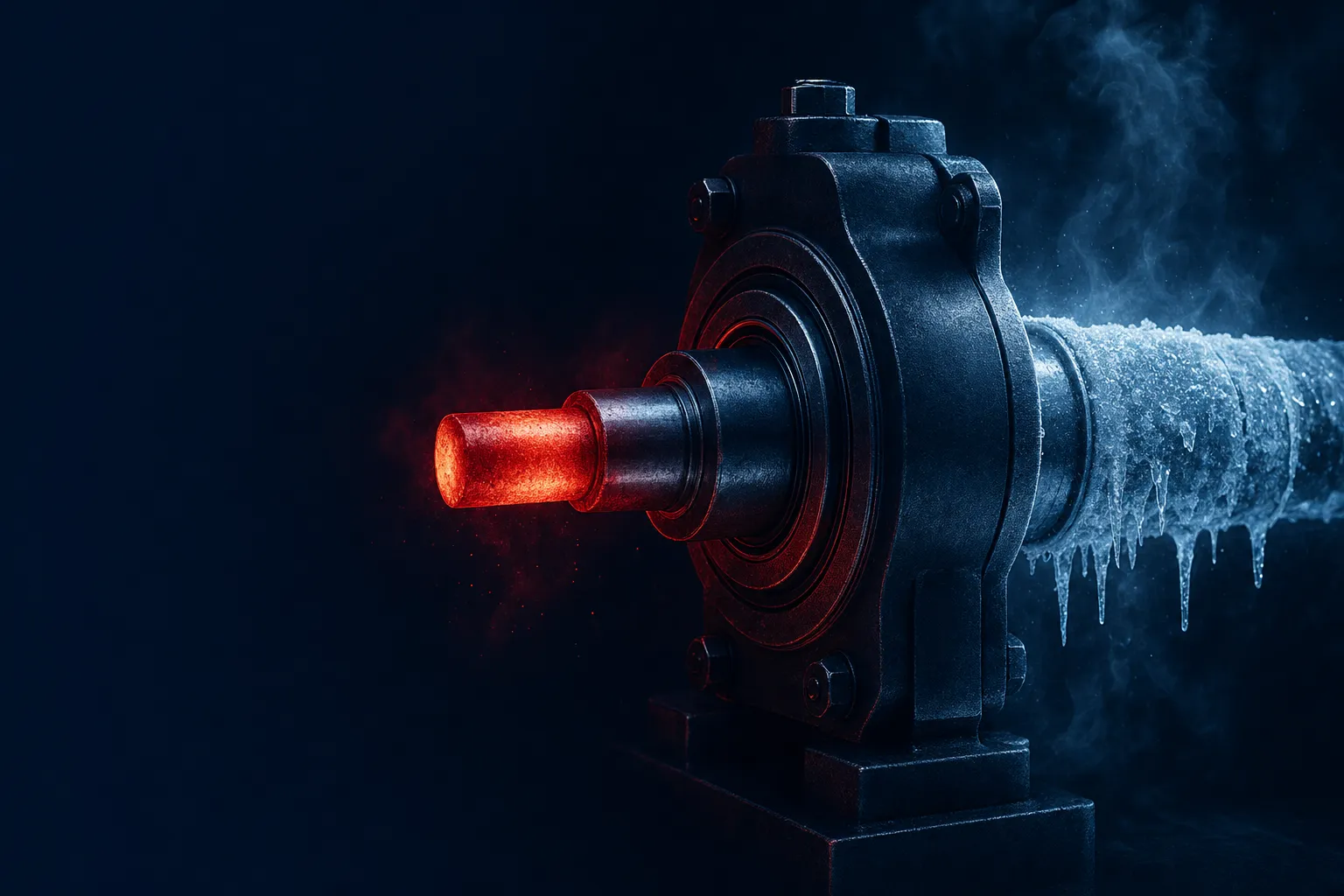
Precipitation-hardening alloys (17-4PH, 6061, 7075, Inconel 718) follow a two-step thermal sequence: solution treat at high temperature (everything dissolves into solid solution), then age at moderate temperature (controlled precipitates form, locking strength in). Different aging temperatures for the same alloy yield different strength/ductility balances.
| Material | Solution temp | Quench | Common aging condition | Result |
|---|---|---|---|---|
| 17-4PH stainless | 1040 °C | Air or oil | H900 — 482 °C, 1 hr | UTS 1310 MPa, 44 HRC |
| 17-4PH (tougher) | 1040 °C | Air or oil | H1150 — 621 °C, 4 hr | UTS 930 MPa, 33 HRC |
| Aluminum 6061 | 529 °C | Water | T6 — 175 °C, 8 hr | UTS 310 MPa |
| Aluminum 7075 | 466 °C | Water | T6 — 121 °C, 24 hr | UTS 572 MPa |
| Aluminum 7075 (SCC-resistant) | 466 °C | Water | T73 — 107 °C/177 °C | UTS 505 MPa, better SCC |
| Inconel 718 | 955 °C | Air | AMS 5663 — 720/620 °C | UTS 1380 MPa |
| Ti-6Al-4V (STA) | 955 °C | Water | STA — 540 °C, 4 hr | UTS 1170 MPa |
Process selection
Pick by what the part needs to do.
01
Need wear resistance
Through-hardened tool steel (A2, D2, S7) or surface-hardened low-carbon steel (carburized, nitrided). For corrosion + wear: hardened 17-4PH or 440C.
Hardness target — 50–62 HRC typical
02
Need impact toughness
Quenched and tempered alloy steel at moderate temper (4140 H, 4340). Avoid over-aging on PH alloys. Charpy V-notch is the right test.
Tempered above 540 °C / 1000 °F

03
Need fatigue resistance
Solution-treated and aged alloys. Avoid welds in fatigue zones. Surface-conditioning treatments (shot peen, ultrasonic peening) compound the gain.
Low residual surface stress; smooth finish
04
Need dimensional stability
Stress-relieve before final machining. For PH alloys, age before final tolerance grinding. For aluminum plate, T651 (stretch-relieved) is the right pick.
Stress relief 540–675 °C, slow cool
05
Need surface hardness with tough core
Carburize (low-carbon steel) or nitride (Cr-Mo alloy steel like 4140). Hardness 60+ HRC at the surface, core stays at the as-quenched-and-tempered hardness.
Case depth callout — typical 0.020–0.060″
06
Need maximum strength period
PH alloys at peak aging condition (17-4PH H900, 7075-T6, Inconel 718 STA). Note: peak strength = lowest ductility.
Lowest aging temp; full peak conditions
Watch out for
Heat treatment moves your part.
Every thermal cycle changes part dimensions. Quenching causes the most dramatic distortion (rapid, asymmetric thermal contraction). Aging is more predictable but still real. The general planning rules:
- Rough machine before HTLeave 0.005–0.020″ stock on critical surfaces. Finish-machine or grind after HT.
- Symmetric geometry distorts lessAsymmetric clamping during quench amplifies distortion. Through-holes, flat plates, and thin-wall parts are the worst offenders.
- Polymer quench beats waterFor 4140-class steels, polymer quench gives ~80% the hardness of water with ~½ the distortion. Worth specifying.
- Aging is your friendPH alloys change size predictably during aging — ~0.0005″/inch for 17-4PH H900, ~0.0009–0.0012″/inch for H1150. (17-7PH TH1050 is the exception: the 1400 °F conditioning step grows parts ~0.0045″/inch, ~0.004″/inch net after aging.) Tighter tolerances can be held through aging vs. quenching.
- Stress-relieve before tight tolerance opsEspecially for thin-wall machining of plate stock. Aluminum plate that hasn't been stress-relieved (T6 vs T651) will spring after machining.
Spec syntax
How to call out heat treatment.
Don’t leave the spec ambiguous. Pick the AMS, MIL, or ASTM spec that matches your alloy and condition, and call out specific hardness/strength targets. Examples:
Keep exploring
Related tools & references
H900 to H1150 — the most-specified heat-treat trade-off we machine.
Convert between HRC, HRB, HV, and HB for your callout.
Estimate effective case depth for carburized and nitrided parts.
Find the AMS number for your alloy and condition.
The finishing step that usually follows heat treatment.
Technically reviewed by the True Precision Machining engineering team · Last reviewed June 2026
Standards referenced: AMS 6382, AMS 5643, AMS 5663, AMS 4027
Need help speccing heat treatment?
Send us your application and the property targets — we'll suggest the right alloy + condition combination and the standard spec to call out.
Quotes in 24 hours