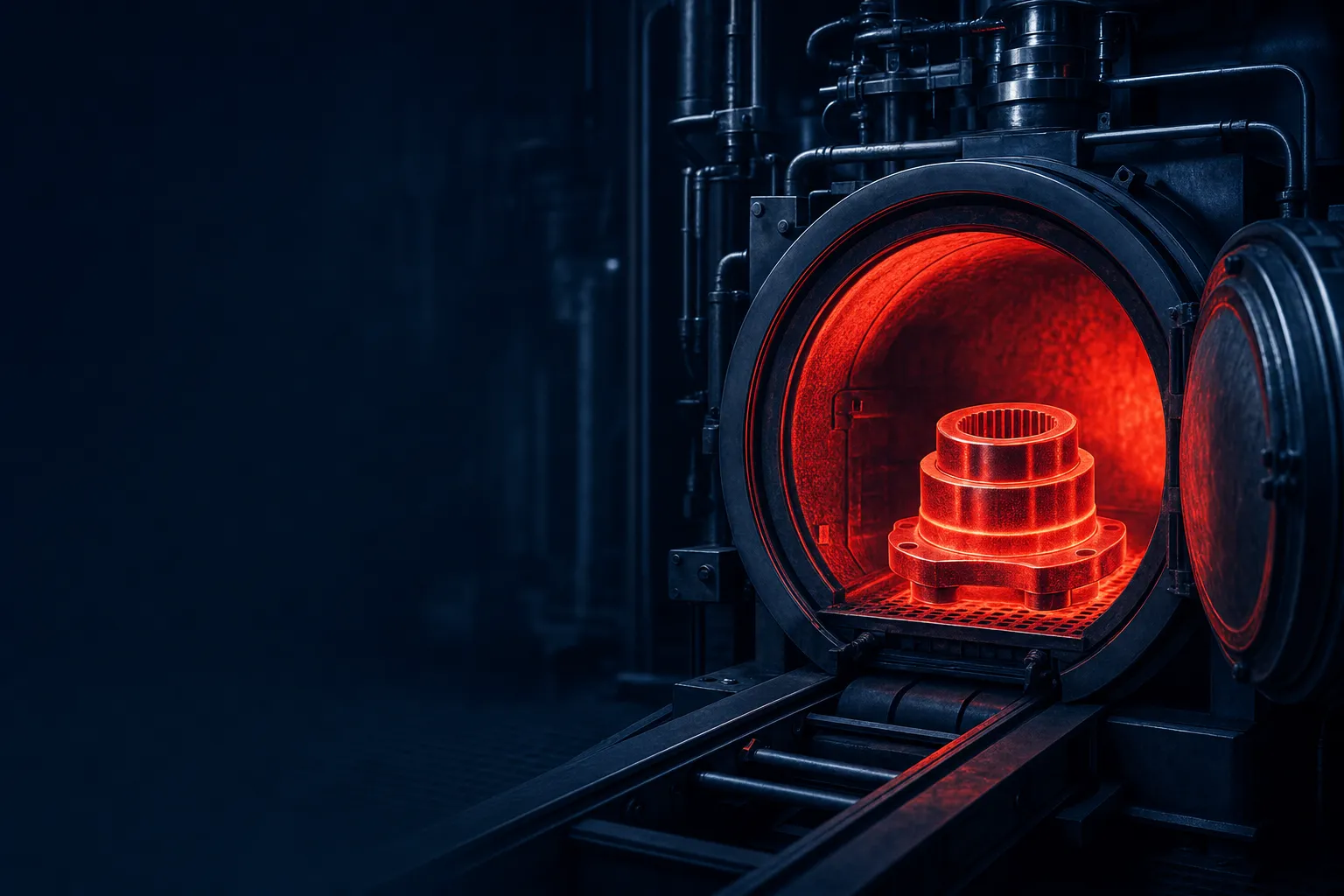
H900
Peak strength
Maximum hardness and tensile strength. Pick for valve trim, surgical jaws, fasteners under high stress. Stress-corrosion cracking susceptibility is the highest of the four — avoid in chloride-rich environments.

Engineering · Comparison
17-4PH is one alloy with four common aging conditions. Each represents a different point on the strength-toughness-corrosion curve. The drawing callout determines which one to use — but understanding the trade-offs helps when the spec needs to change.
| Property | H900 | H1025 | H1075 | H1150 |
|---|---|---|---|---|
| Aging temp | 482 °C / 900 °F | 552 °C / 1025 °F | 580 °C / 1075 °F | 621 °C / 1150 °F |
| UTS (ksi, A564 min) | 190 | 155 | 145 | 135 |
| 0.2% YS (ksi, A564 min) | 170 | 145 | 125 | 105 |
| Hardness (HRC, typical) | 44 | 38 | 36 | 33 |
| Elongation (%, A564 min) | 10 | 12 | 13 | 16 |
| Charpy V-notch (ft-lb, typical) | 15 | 30 | 40 | 55 |
| Stress-corrosion crack | Susceptible | Better | Good | Best |
H900
Maximum hardness and tensile strength. Pick for valve trim, surgical jaws, fasteners under high stress. Stress-corrosion cracking susceptibility is the highest of the four — avoid in chloride-rich environments.
H1025
The most-cited 17-4PH condition for aerospace structural and defense pin/fastener work. Good strength, better toughness than H900, improved SCC resistance.
H1075
Slight strength penalty vs H1025 for meaningful improvement in stress-corrosion resistance. Specified for marine fasteners and chloride-environment service.
H1150
Lowest strength, highest toughness and best SCC resistance. Pick when impact toughness or fatigue under aggressive chemistry matters more than peak strength.
Process notes
Stock arrives as Condition A (solution annealed, ~33 HRC). Rough & semi-finish in this state, then heat-treat to the specified H-condition. Final finishing on the aged material if tight tolerance required.
17-4PH shrinks ~0.04–0.06% during aging (H900 condition), and slightly more in the higher-temperature conditions. For thin sections, leave 0.005–0.010″ stock for finish operations after heat treat. For thicker work, distortion is usually within standard tolerance.
At 44 HRC, post-aging finish operations need rigid setups, sharp tooling, and careful feeds. Many shops machine fully in Condition A and accept the as-aged dimensional shift.
AMS 5643 (bar and forgings) covers all four H-conditions — the supplier certifies to whichever the drawing calls out. AMS 5862 is the closely related 15-5PH sheet/strip/plate spec (H900), a 17-4 variant rather than 17-4PH itself. See our AMS spec cross-reference for the full list.
Keep exploring
Full mechanical and chemical properties for the alloy.
Machining Condition A vs aged, and finishing strategy.
How solution treatment and aging produce each H-condition.
Why citric is the safer choice on aged 17-4PH surfaces.
AMS 5643, 5862, and related callouts for PH stainless.
Technically reviewed by the True Precision Machining engineering team · Last reviewed June 2026
Standards referenced: AMS 5643, AMS 5862
We machine 17-4PH in Condition A and coordinate aging to the H-condition your drawing calls out. Send us the drawing and the AMS callout for valve, fastener, or structural work.
Quotes in 24 hours