


Industries · Space & Satellite
Flight hardware. The kind that doesn't come back.
Space programs hold the highest quality bar in machined hardware — vacuum-grade materials, cryogenic stability, no second chances after launch. We machine components for NASA flagship missions including the James Webb Space Telescope and Europa Clipper, plus commercial satellite hardware.
01 · NASA flight hardware
Programs we machine for.
NASA imagery and program names are public; the components we contribute, the customer relationships, and the build details are not. The programs below are listed because they are public knowledge — supplier credit on NASA missions is the kind of credential that says everything else about how the shop runs.
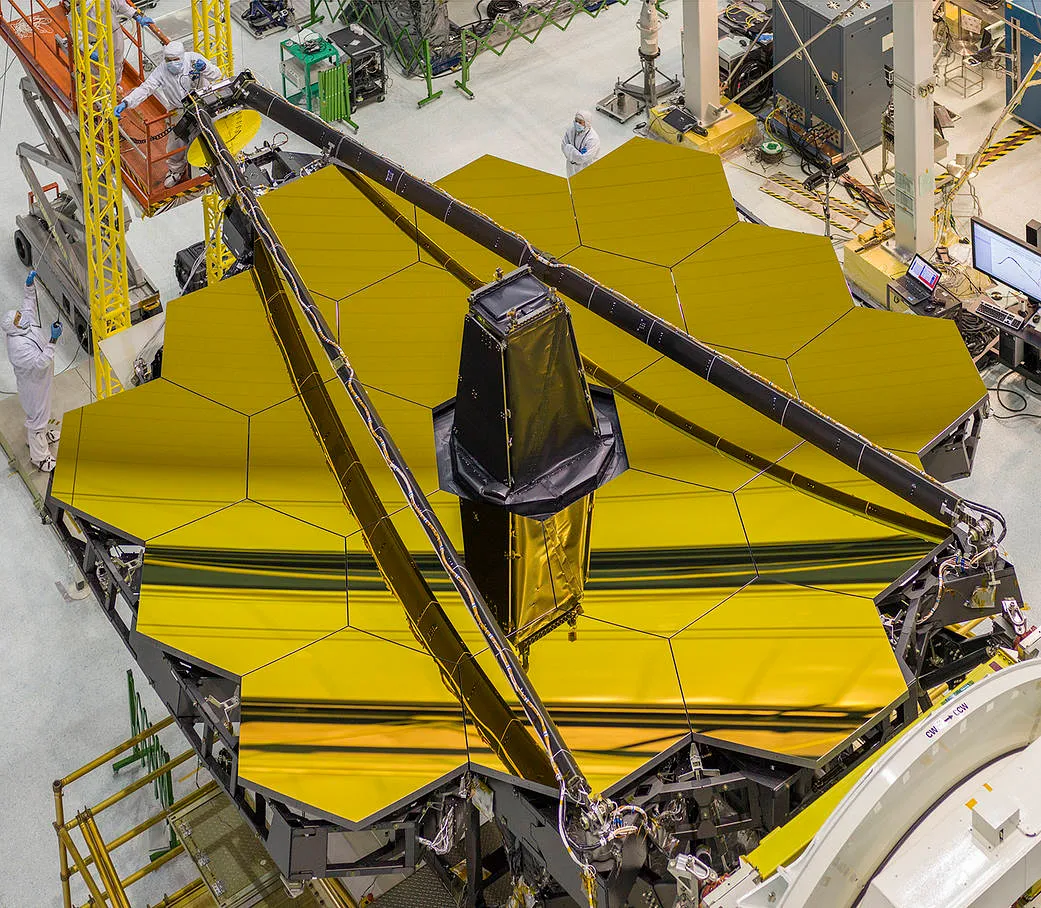
NASA's flagship infrared observatory — 18 hexagonal beryllium primary mirror segments, 6.5 m aperture, operating at 50 K at L2. Launched December 2021; first science July 2022.

NASA's Jupiter mission to characterize the habitability of Jupiter's moon Europa. Largest planetary spacecraft NASA has ever built. Launched October 2024; arrives April 2030.
Imagery: NASA / Chris Gunn (JWST), NASA / JPL-Caltech (Europa Clipper). NASA work-product is in the public domain.
02 · What space hardware demands
Why most shops can’t do this work.
- Vacuum & cryogenic compatibility
Outgassing-controlled materials, no organic contamination. MIC-6 cast aluminum, OFHC copper, Ti-6Al-4V grade 5, vacuum-grade stainless.
- Dimensional stability over launch + thermal cycle
Partner-coordinated stress relief on plate; symmetric cut sequences; thermal-shock cycling validation. Drift budgets often <0.0001″ over 30+ days, with 0.0001″-class features held on wire-EDM, ground and Swiss operations.
- Surface finish for joining + cleanability
8 µin Ra typical as machined; 4 µin on vacuum-joining surfaces via coordinated lapping/polishing. Bead-blast or partner polish per spec.
- Traceability to material lot
AMS / ASTM spec to raw stock heat number to part serial. NASA-grade documentation chain.
03 · Beyond NASA
Commercial satellite work, too.
Commercial small-sat constellations, hosted-payload hardware, ground-segment optical fixtures, and antenna-feed components for SATCOM platforms. The same vacuum-discipline carries across — outgassing-controlled materials, surface-finish callouts, and dimensional-stability validation under thermal cycling.
One example from our shop floor: we eliminated dimensional drift on a precision optical mount via material substitution and pre-machining thermal stabilization.
Building flight hardware?
Send drawings or a STEP file — we'll review for vacuum compatibility, dimensional-stability planning, and material substitution before we quote.
Quotes in 24 hours