



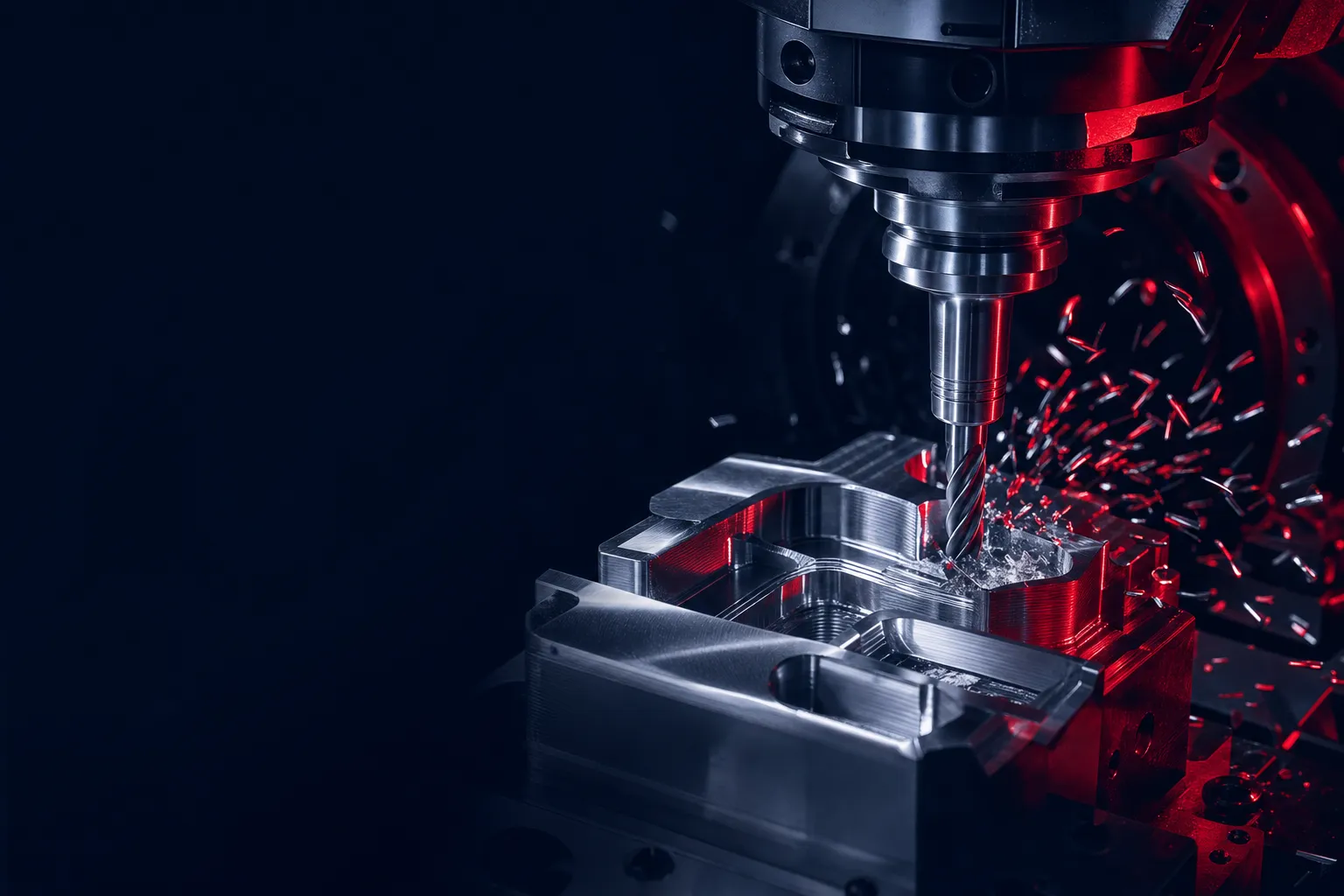
Engineering · Machining guide
How to machine Inconel 718.
Inconel 718 is one of the most difficult common aerospace alloys to machine. Heat doesn’t go into the chip — it stays at the cutting edge and softens the binder. This guide covers cutting parameters, tool selection, coolant strategy, and the operational pitfalls that ruin tools and parts.
01 · Why it’s hard
Heat physics, not toughness.
Inconel 718’s thermal conductivity is 11.4 W/m·K — about 70% of austenitic stainless and 1/15 of aluminum. Heat from the cut can’t escape into the chip the way it does in normal materials. Instead, it concentrates at the tool-workpiece interface and softens the carbide binder.
The work-hardening compounds the problem. Inconel 718 hardens rapidly when worked, so a dull tool creates harder workpiece material in front of it, accelerating tool wear. Aged 718 (the STA condition per AMS 5663) is even tougher because of the γ″ (gamma-double-prime) precipitates.
Three principles drive successful Inconel machining: keep the chip moving (no rubbing, no dwell), flood the cutting zone with coolant for carbide work or go dry-and-fast for ceramic, and replace tools on schedule, not when they fail.
02 · Tool selection
Carbide for finishing, ceramic for roughing.
- Coated carbide (PVD AlTiN, TiAlN)
For finish operations and surface-finish-critical features. AlTiN coating handles the heat better than TiN. Sub-micron grain carbide preferred. Run with HPC flood at 35–60 SFM.
- Whisker-reinforced ceramic (SiC-whisker alumina, e.g. Greenleaf WG-300) or SiAlON grades
For roughing only. Run dry at 600–800 SFM with heavy chip load. The chip turns red-hot in front of the tool — exactly the operating regime ceramic was designed for. Ceramic surface finish (Ra ~64 µin) isn’t adequate for AMS specs, so it’s roughing only with carbide finish.
- CBN inserts
For finishing aged Inconel 718 (post-heat-treat). Specifically for hard-turning of 44 HRC material where carbide gives up tool life. Premium cost, long life on the right work.
- Solid carbide end mills
4-flute or 6-flute, sub-micron grain, AlTiN coating. Avoid HSS — won’t survive the heat.
- Geometry
Positive rake, 0.0004–0.0008″ honed cutting edges. Sharp edges chip; dull edges rub. Honed edges balance both.
03 · Cutting parameters
Numbers that work.
| Operation | Tool | SFM | IPT / IPR | DOC |
|---|---|---|---|---|
| Roughing turn | Coated carbide | 30–50 | 0.012–0.020 IPR | 0.060–0.150″ |
| Roughing turn | Ceramic (SiAlON) | 600–800 | 0.008–0.015 IPR | 0.060–0.100″ |
| Finishing turn | Coated carbide | 60–80 | 0.005–0.010 IPR | 0.020–0.030″ |
| Finishing turn | CBN | 500–700 | 0.003–0.006 IPR | 0.005–0.010″ |
| End mill (rough) | Solid carbide | 30–50 | 0.002–0.004 IPT | 0.5× dia |
| End mill (finish) | Solid carbide | 60–80 | 0.001–0.002 IPT | 0.030″ |
| Drilling | HSS-Co | 20–30 | 0.001–0.003 IPR | — |
IPT (chip-load) values assume roughly ½–1″ end mills; scale down for smaller tools — see the chip-load chart.
Higher hardness (aged 718) needs ~20% lower SFM. Annealed 718 (Condition A) machines closer to 17-4PH numbers.
04 · Coolant strategy
Carbide flood. Ceramic dry.
- Carbide: high-pressure through-tool coolant (1000+ PSI ideal, flood acceptable). Cools the cutting edge and flushes chips.
- Ceramic: dry. Coolant thermal-shocks the insert and chips it. The chip carries the heat away.
- CBN: dry or minimum-quantity lubrication (MQL). Same thermal-shock concern as ceramic.
- Coolant chemistry: chlorinated or sulfo-chlorinated EP grades are fine for carbide (Haynes recommends sulfo-chlorinated oils for nickel alloys). The real issue is residue: sulfur left on the part embrittles nickel alloys when heated, so clean thoroughly before aging, welding or any heat treatment.
- Chip evacuation: mandatory for long cycles. Chip pack-in around a tool in Inconel kills the tool in seconds.
05 · Common pitfalls
What goes wrong.
- Tool dwelling kills tools.
Stopping the spindle while the tool is engaged, or pausing mid-cut, work-hardens the surface and creates a hard layer the next pass has to chew through. Avoid dwell-stops mid-cut.
- Climb mill, don’t conventional.
Conventional milling rubs the chip back into the work — heating it, hardening it. Climb milling lifts the chip away from the cut. Always climb in Inconel.
- Don’t reduce feed when in doubt.
Counterintuitive — reducing feed in Inconel often makes things worse because the tool spends more time rubbing without breaking the chip. Maintain proper chip load.
- Replace tools on schedule, not on failure.
Tool failure in Inconel is sudden and catastrophic. Establish tool-life cycle counts and replace before the wear curve climbs.
- Aged material vs annealed material runs differently.
If the drawing specifies aged condition (AMS 5663), check whether you’re machining aged stock or annealed stock that gets aged after machining. The right answer is almost always: machine in annealed (Condition A), age after rough, finish on aged material if tight tolerance is needed.
Real example
Inconel turbine vane: ceramic-insert roughing.
On an aerospace customer’s Inconel 718 turbine vane program, switching roughing from coated carbide at 35 SFM to whisker-reinforced ceramic at 700 SFM doubled tool life and dropped cycle time 30% — qualified, documented, and repeatable.
Keep exploring
Related tools & references
Precipitation-hardening superalloy properties and conditions.
Pick the right nickel alloy for the application.
Set carbide and ceramic SFM for aged and annealed 718.
Maintain chip load — don't reduce feed in Inconel.
8.19 g/cc — stock and finished-part weights.
Technically reviewed by the True Precision Machining engineering team · Last reviewed June 2026
Standards referenced: AMS 5662, AMS 5663
Inconel 718 part on your desk?
Send the drawing — we'll quote it with a real tooling and parameter strategy, not generic carbide and finger-crossed feeds.
Quotes in 24 hours